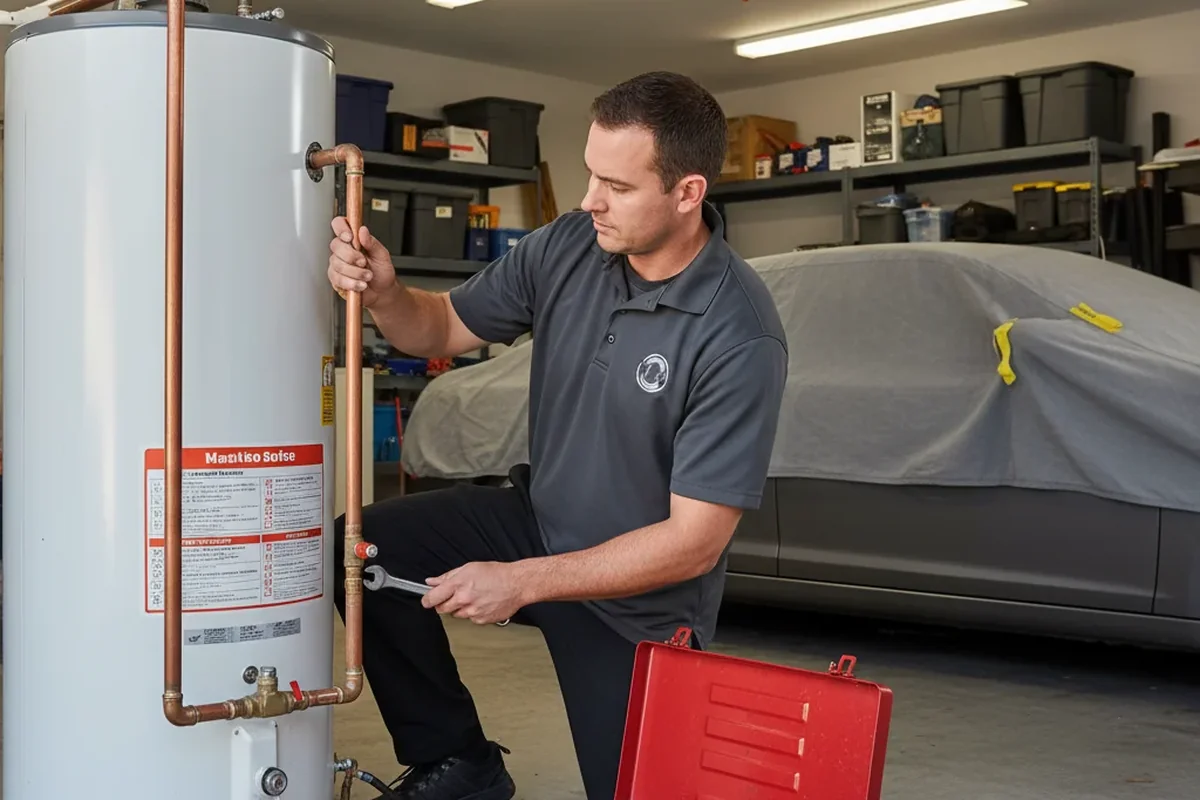
The TPR Valve: Your Tank's Last Line of Defense
The temperature-pressure relief valve — TPR valve for short — is a small brass valve threaded into the side or top of your water heater, with a discharge pipe running down toward the floor. Its job is beautifully simple: if the water temperature exceeds about 210 degrees or the pressure tops 150 PSI, the valve opens and dumps hot water out of the tank, relieving the dangerous condition before the tank itself fails.
This is not a convenience feature. A water heater is a sealed pressure vessel, and superheated water in a sealed vessel is a steam explosion waiting for a trigger. The TPR valve is the engineered last resort that prevents that outcome. Every tank heater must have one, it must work, and its discharge path must be clear — there is no acceptable workaround.
Why TPR Valves Drip: Three Different Causes
A dripping TPR valve is the most common complaint, and it has three distinct causes. The first is a failed valve: the internal spring weakens or mineral deposits prevent the seat from sealing, and it weeps constantly. The second is excessive system pressure — municipal pressure too high or a failed pressure regulator — holding the valve near its opening point. The third is thermal expansion: heating water expands it, and in a closed plumbing system with no expansion tank, each heating cycle spikes the pressure until the valve burps.
The discharge pattern distinguishes them. Constant dripping suggests a bad valve or constant high pressure. Discharge only after the burner or elements run points to thermal expansion. A valve that suddenly starts gushing may be responding to a genuine overheat — a failed thermostat — which is the emergency the valve exists for. Diagnosis sorts these out before any part is replaced.
Replacement, Step by Step — Plus the Pressure Check
Replacement starts the way all tank work starts: energy off, water supply off, tank cooled and depressurized. The discharge pipe is disconnected from the old valve, the valve is unthreaded from the tank port, and the port threads are cleaned and inspected — corrosion here is common and must be addressed so the new valve seats properly.
The new valve, matched to the tank's pressure rating and BTU relief capacity, threads in with approved sealant and is oriented so the discharge pipe can run properly downward. The discharge pipe is reconnected (or corrected — see below), the tank is refilled and reheated, and the system is observed through a full cycle. Critically, the technician also checks system pressure with a gauge: if pressure is high or expansion is uncontrolled, the new valve gets the support it needs — a regulator adjustment or an expansion tank — rather than being left to drip like its predecessor.
The Discharge Pipe: Half the Safety System
The discharge pipe is half the safety system and gets half the attention. Code requires it to run downward from the valve, stay the full diameter of the valve outlet, terminate within inches of the floor or into an approved drain, and have no shutoff, cap, or threaded end anywhere along its length. It must discharge where hot water will be noticed but will not scald someone.
Real-world installs violate these rules constantly: pipes running uphill into a wall, pipes terminating at head height over a walkway, pipes necked down to a smaller size. During a TPR replacement the technician corrects whatever the old install got wrong, because a perfect valve with a blocked or misrouted discharge pipe protects no one.
Safety Rules: Never Defeat the Relief Path
TPR work has one absolute rule: never defeat the safety device. The discharge pipe is never capped, plugged, or valved — not temporarily, not "just until the part arrives." A plugged TPR line on an overheating tank is how explosions happen. If the valve is discharging, the energy source gets shut off; the relief path stays open.
Testing has its own caution: lifting the test lever on a very old valve can prevent it from reseating, turning a test into an immediate replacement. That is not a reason to skip testing — it is a reason to test when you are prepared for the outcome. Discharge water is near boiling, so the test is done with the discharge path clear and everyone clear of it.
High Pressure, Hard Water, and Colton TPR Valves
Colton's water systems give TPR valves plenty to do. Municipal pressure runs high in parts of the Inland Empire, and many Colton homes sit on closed systems — pressure regulators or backflow preventers with no expansion tank — where every heating cycle spikes pressure against the TPR valve. If your valve drips mainly after the heater runs, expansion is the likely story, and an expansion tank is the lasting fix.
Hard water shortens TPR valve life directly: mineral deposits crust the seat and spring, causing the constant weep that gets misdiagnosed as a pressure problem. And in Colton's older garage installs, discharge pipes are frequently found terminating into walls or uphill — legacy work from before current standards. A TPR visit here often becomes a small safety overhaul. back to our homepage for our full service lineup, see the areas we serve, or if the drip might be something else entirely, start with water heater leak detection. Call (833) 713-2101.