Colton, CA
Water Heater Leak Repair Services in Colton, CA
Water heater leak repair services in Colton, CA: leak detection, tank & tankless repair, valves, elements, pans & replacement. Call (833) 713-2101.
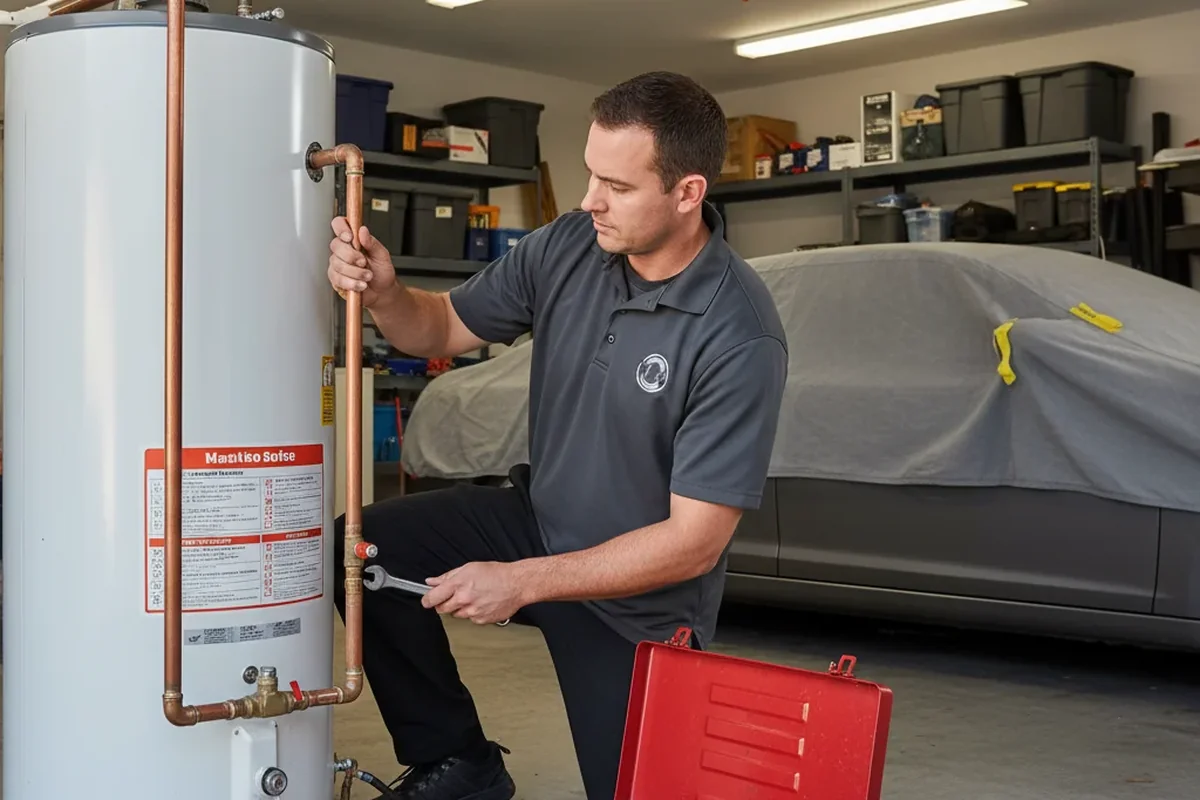
Water heater leak repair services in Colton, CA: leak detection, tank & tankless repair, valves, elements, pans & replacement. Call (833) 713-2101.
A leaking water heater is never just one problem — the water you see can come from a failed tank, a corroded fitting, a stuck valve, or a worn-out component, and each one calls for a different fix. That is why we built our service list around the failures Colton's hard water actually causes. Every service below starts the same way: we find the true source of the leak, explain your options in plain language, and give you straightforward pricing before any work begins. Browse the services, then call (833) 713-2101 — most repairs are completed in a single visit.
Walk into your garage on a 102-degree Colton afternoon and you may notice it before you see it: a faint mineral smell, a dark halo spreading across the concrete under the water heater, the soft tick of drips landing in a drain pan. In the Hub City, this scene plays out every week. Colton's housing stock runs on storage-tank water heaters — 1950s through 1970s ranch homes, 1980s and 90s tracts, and a deep bench of rental properties — and those tanks are filled with some of the hardest municipal water in the Inland Empire. Drawn from the Bunker Hill Basin and blended with imported State Water Project supplies, Colton water carries a heavy load of calcium and magnesium. Inside a water heater, that mineral load builds scale, buries the tank bottom in sediment, and chews through anode rods in two to four years. Once the rod is gone, the steel tank wall becomes the next thing to corrode. A leak is rarely a surprise. It is usually the final chapter of a story the water has been writing for years. Tank water heater leak repair starts with a question most homeowners never think to ask: where exactly is the water coming from? A wet tank is not automatically a dead tank. Some of the most common so-called tank leaks in Colton turn out to be a weeping relief valve, a corroded outlet fitting, a failed drain valve, or a flex connector sweating at its threads — all repairable, and all far cheaper than a replacement. The tank body itself is a different story. Once corrosion perforates the steel wall or a weld seam, no patch or sealant restores it, and an honest diagnosis means saying so plainly. Our job is to trace the water to its source, show you what we found, and give you a straight answer about whether repair makes sense or replacement is smarter. Because we work Colton every day, we read these tanks the way a mechanic reads an engine. We know what a Bunker Hill Basin scale load looks like inside a ten-year-old tank, we know which garage installations are missing earthquake straps or a proper drain pan, and we know California's replacement rules cold — seismic strapping, drain pans with drain lines where required, and Title 24 efficiency standards — so if your repair turns into a replacement, nothing gets missed. Most tank leak calls get same-day attention, and many fitting repairs finish in a single visit. If water is pooling where it shouldn't be, call Water Heater Leak Repair Crew at (833) 713-2101 and we will get someone out to take a look.
A tankless water heater is not a tank with the tank removed. It is a precision machine: a copper or stainless-steel heat exchanger threaded with waterways narrower than a pencil, a modulating gas burner or electric element firing on demand, sensors watching flow and temperature a dozen times a second. There is no forty gallons of stored water waiting to rust through a steel wall — and that is exactly why tankless leaks confuse people. When a tankless unit drips in a Colton garage or on an exterior wall, the water is coming from somewhere far more specific: a pinhole in the heat exchanger, a fatigued O-ring, a service valve weeping at its packing, a condensate line backing up. Each of those has a different cause, a different fix, and a different urgency. In Colton, one suspect tops the list on nearly every call, and it comes out of the tap: hard water. Scale is the slow-motion catastrophe of tankless ownership in the Inland Empire. Colton's municipal supply — Bunker Hill Basin groundwater blended with imported State Water Project water — carries enough calcium and magnesium to choke a heat exchanger's narrow passages in as little as a year or two without descaling. Scale insulates the exchanger walls, forcing the burner to run hotter; hotter metal under thermal stress develops micro-fractures; micro-fractures become pinholes; pinholes become the drip you found on the garage floor. Many of the tankless leaks we repair in Colton trace back to a unit that was installed with enthusiasm and then never descaled — a five-thousand-dollar appliance slowly strangled by minerals. The good news is that most tankless leak points are serviceable components, not death sentences, and a proper descaling often reveals that the unit has years left once the scale is gone. Tankless leak repair is a different trade from tank repair, and it rewards a technician who knows the machine. Our visits start with isolation — water, gas, and power secured — then move through a methodical check: service valves, condensate routing, the exchanger itself, and the error history on the unit's display, which often names the problem before we open a panel. Because Colton water is the root cause so often, descaling is built into our diagnostic process rather than sold as an add-on. If your tankless unit is dripping, throwing error codes, or swinging between scalding and cold, call Water Heater Leak Repair Crew at (833) 713-2101. We'll find the actual leak, fix what's fixable, and set you up on the descaling rhythm that keeps it from coming back.
The most expensive water heater leaks are the ones you never see. In Colton, they hide with embarrassing ease: garage concrete wicks a slow drip outward into a wide, faint stain instead of a telltale puddle; a 105-degree summer afternoon evaporates the evidence before dinner; an insulation blanket wrapped around an older tank conceals weeping fittings for months. By the time a homeowner notices — a musty smell that wasn't there in spring, a City of Colton water bill that jumped for no reason, drywall soft at the base of the garage wall — the water has been working quietly for weeks. Leak detection exists for exactly this gap between the first drop and the first clue, and in a hard-water city where heaters corrode from the inside out, that gap is where the real damage happens. Detection is a discipline, not a guess. It starts with the house's own testimony: water bills, smells, stains, sounds, and the mineral crust that Colton's calcium-heavy water leaves wherever it dries. Then it moves to instruments — moisture meters that read inside walls without opening them, thermal imaging that sees the temperature signature of hidden water, pressure tests that reveal whether a closed system is losing water somewhere it shouldn't. The point is never just to confirm that water exists. Anyone with eyes can do that once the damage is visible. The point is to trace it to its exact source: the water heater or the irrigation line, the TPR discharge or the slab, a failed fitting or a failing tank — because the fix for each is completely different, and fixing the wrong one is money burned. If something in your home suggests water is going where it shouldn't — the bill, the smell, the stain, the sound of running water when everything is off — don't wait for it to become obvious. Obvious means expensive. Call Water Heater Leak Repair Crew at (833) 713-2101 and we'll come find it. Our detection visits are methodical and non-destructive: we trace the water, show you the evidence, and hand you a clear picture of what's leaking, how bad it is, and what fixing it actually takes. In Colton's hard water and summer heat, early detection is the difference between a service call and a renovation.
Inside every tank water heater in Colton there is a metal rod with one job: to die so the tank doesn't have to. It's called the anode rod — usually magnesium or aluminum-zinc, about as thick as your thumb, threaded into the top of the tank and hanging down into the water. Through a quiet electrochemical process, it corrodes preferentially, drawing the corrosive forces in the water to itself and sparing the steel tank wall. It is the single most important wear part in the entire appliance, and almost nobody knows it exists. In soft-water cities, a rod might last six or eight years. In Colton, fed by mineral-dense Bunker Hill Basin groundwater blended with State Water Project imports, the rod's lifespan collapses to two to four years. When it's gone, the tank starts corroding instead — and the countdown to a leaking tank begins. Here's the part that stings: nearly every premature tank failure we see in Colton traces back to a rod that died unreplaced. The sequence is always the same. Year two or three: the rod is significantly consumed. Year four: it's gone, or reduced to a bare wire. From that point the steel shell takes the electrochemical hit directly, and corrosion that should have attacked a replaceable fifteen-dollar part attacks the tank wall instead. By year eight or nine, pinholes open at the welds or the tank base, and the homeowner buys a new water heater — never knowing that a single rod replacement at year three would likely have bought five more years. Anode rod replacement is the cheapest life insurance a water heater can get, and in this city's water, it's not optional maintenance. It's the maintenance the water demands. Replacing a rod sounds simple, and on a new tank in a tall garage, it nearly is. On a ten-year-old Colton tank, it can be a wrestling match: rods seize in their threads with a decade of mineral cement, garage ceilings sit too low to pull a rigid rod straight out, and tanks that have never been serviced fight every step. That's why this is a technician's job, not a Saturday project — we carry the breaker bars, the impact tools, the segmented flexible rods for low-clearance garages, and the judgment to know when a tank is too far gone for a rod to help. If your tank is over three years old and the rod has never been checked, you're overdue. Call Water Heater Leak Repair Crew at (833) 713-2101 and we'll inspect it, show you what we find, and replace it if it's spent.
Every tank water heater has one part whose entire job is preventing a catastrophe: the temperature-and-pressure relief valve, the little brass valve threaded into the top or upper sidewall with a pipe running down toward the floor. If tank temperature ever exceeds 210 degrees or pressure tops 150 psi, the TPR valve opens and dumps water — loudly, dramatically, and exactly as designed — rather than letting the tank become a pressure vessel with no exit. It is the cheapest life-safety device in your home. And in Colton, it is also one of the most commonly dripping components we get called about, because this city's hard water crusts valve seats with mineral deposits, and its municipal pressure runs high enough in places to keep marginal valves weeping around the clock. A dripping TPR valve is your water heater trying to tell you something, and the message matters. Sometimes the valve itself has simply failed — the spring weakened, the seat crusted with calcium, the seal no longer seating — and replacement is the whole fix. But often the valve is the messenger, not the problem: thermal expansion in a closed plumbing system, a failed expansion tank, or street pressure spikes (Santa Ana wind events can swing municipal pressure) are driving pressure past the valve's setpoint, and the valve is doing its job by relieving it. Replacing the valve without addressing the cause buys you a new valve that starts dripping next month. Our TPR service is built around telling those two situations apart, because the fix — and the safety implication — is completely different. Two things you should never do with a dripping TPR valve: ignore it, and cap it. Ignoring it wastes water and lets the underlying pressure problem hammer your tank, washing machine valves, and faucet cartridges. Capping the discharge pipe — or plugging the valve — removes the tank's last line of defense, and that is genuinely dangerous. What you should do is call Water Heater Leak Repair Crew at (833) 713-2101. We'll diagnose whether the valve failed or the system is overpressurizing, replace the valve to California code with proper discharge piping, and fix the root cause — expansion control, pressure regulation, or both — so the new valve sits quiet for years. Same-day service for actively discharging valves.
It's the most-touched, least-thought-about part on your water heater: the little spigot near the bottom of the tank, the one you (or somebody) use once a year to flush sediment and otherwise ignore completely. The drain valve has a humble job description — let water out of the tank in a controlled way — but it turns out to be load-bearing for the whole appliance. It's how you flush the sediment that Colton's hard water deposits by the bucketful. It's how a technician drains the tank for any major service. And in an emergency, it's how you get forty gallons of water out of a failed tank before it goes where you don't want it. When the drain valve works, you never think about it. When it doesn't — dripping, snapped, clogged solid, or fused in place by a decade of mineral cement — it has a way of announcing itself at the worst possible moment. In Colton, drain valves fail more often and more dramatically than in soft-water towns, and the reasons are all local. Most tanks ship from the factory with a cheap plastic drain valve — fine for a showroom, marginal for a decade of Bunker Hill Basin water. Sediment packs around and inside the valve body until the little plastic gate can't close; mineral deposits cement the threads; summer garage heat cycling makes the plastic brittle. Then comes the day someone actually tries to use it — the annual flush, a service visit — and the handle snaps off in their hand, or the valve opens and won't close again, or nothing comes out at all because sediment has packed the port solid. We get the call at that moment, usually with water running where it shouldn't be and a homeowner holding a broken piece of plastic. The fix is straightforward and the upgrade is worth it: we replace failed drain valves with full-port brass ball valves — the kind that opens fully, drains fast, resists mineral cement, and will still be working in fifteen years. The visit usually includes a proper sediment flush while we're at it, since we're already draining the tank and Colton tanks always need it. If your drain valve is dripping, stuck, broken, or just the original plastic one on a tank you plan to keep, call Water Heater Leak Repair Crew at (833) 713-2101. It's a quick visit, it's inexpensive, and it restores the one part of your water heater you're supposed to actually use.
Gas valve failing in Colton, CA? Pilot won't stay lit or no hot water? We replace gas control valves fast.
No hot water in Colton, CA? Burned-out heating elements are common in hard water. We replace elements fast.
Water too hot or cold in Colton? A faulty thermostat wastes energy and risks scalding. We replace them fast.
Water heater flooding in Colton, CA? Burst tank or major leak? We respond fast to water heater emergencies.
Old water heater leaking in Colton, CA? We assess whether repair or replacement saves you more.
No drain pan under your Colton, CA water heater? One leak can ruin floors and walls. We install pans right.
Every leak tells a story, and in Colton the story usually starts with hard water. Our technicians begin with detection — tracing moisture to its source rather than guessing — because a puddle under the tank can mean a failed drain valve, a weeping TPR valve, or a tank that has rusted through from the inside. Each of those calls for a different fix, and getting the diagnosis right the first time is what keeps a simple visit from turning into a return trip.
For tank units, which still heat most Colton homes, the common culprits are anode rods exhausted by mineral-heavy Bunker Hill Basin water, heating elements buried in sediment, and thermostats thrown off by scale. Tankless units have their own leak points — heat exchangers, condensate lines, and fittings stressed by thermal cycling. Our service list covers both, plus the safety valves and pans that California code requires, so one call handles the whole system.
When a heater is past saving, we say so plainly and walk through replacement options sized for the household, including earthquake strapping and drain pan installation to meet current code. And when the leak cannot wait — water spreading across a garage floor at midnight — our emergency line is answered around the clock. Call (833) 713-2101 and a real person will talk through what to shut off while help is on the way.
The question comes up on almost every service call, and the answer depends on age, condition, and what failed. A six-year-old tank with a bad drain valve is a repair — straightforward, same-day, and cost-effective. A fourteen-year-old tank with a rusted bottom and a weeping seam is a replacement candidate, because the next failure is already forming. We put the heater’s age, the water quality it has lived in, and the cost of each path side by side so you can decide with clear eyes.
Hard water shortens the decision timeline in Colton. National averages say 8 to 12 years for a tank; on Bunker Hill Basin water with no maintenance, we regularly see tanks give out at 7 or 8. Regular flushing and timely anode rod replacement push that back toward — and sometimes past — the national range. Whatever your heater’s age, we will tell you honestly where it stands.