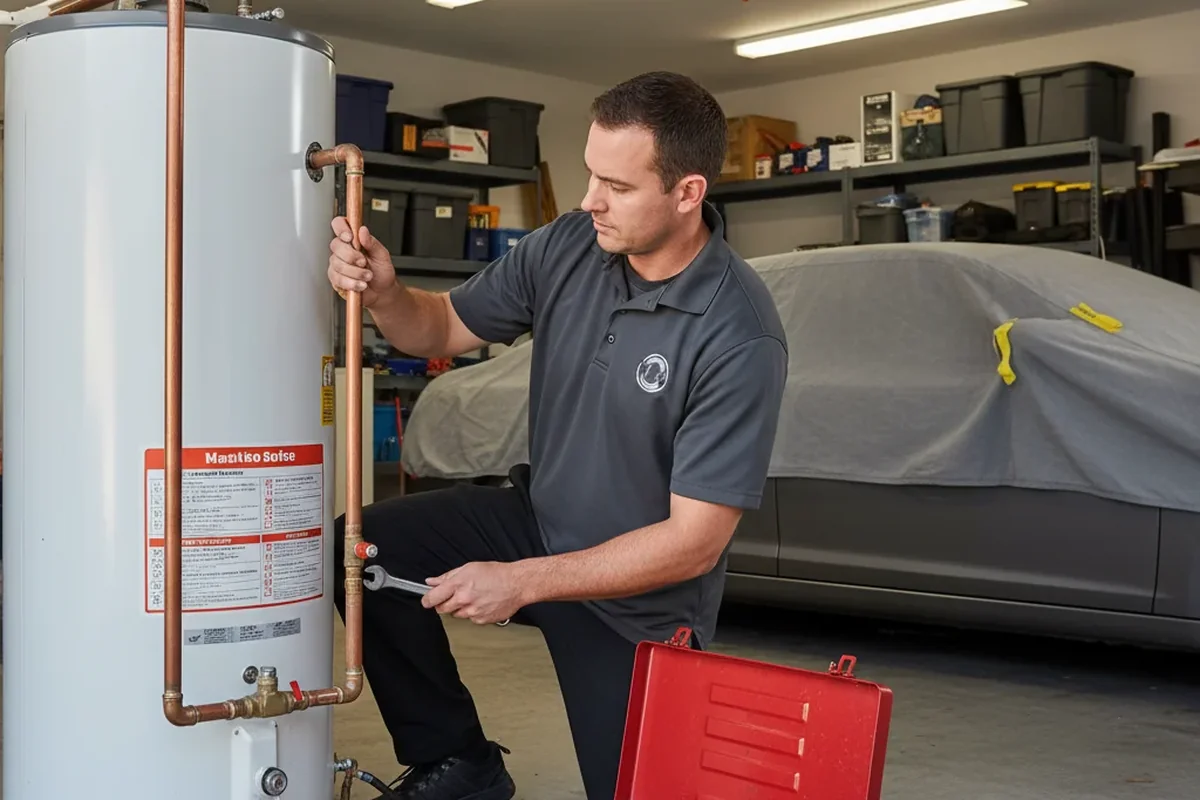
Where Tank Leaks Actually Come From
A tank water heater holds thirty to fifty gallons of hot, pressurized water inside a steel shell, so when water appears where it should not, the stakes are immediate. But not all tank leaks are equal. The most common sources are actually above or around the tank rather than the tank itself: inlet and outlet fittings, the temperature-pressure relief valve and its discharge pipe, the drain valve at the base, and the threaded ports for the anode rod or elements.
True tank-shell leaks — water weeping through the steel wall, seams, or base — are a different category. They mean corrosion has eaten through the metal, and no fitting replacement fixes that. The entire repair decision hinges on this distinction: components can be repaired, but a breached pressure vessel must be replaced. Finding which one you have is the whole job.
Finding the True Source: Dry, Watch, Isolate
The first thing a technician does is also the simplest: dry everything and watch. Water obeys gravity, so the highest wet point is usually the source — a drip from a top fitting runs down the shell and pools at the base, masquerading as a tank failure. Pipe dope residue, mineral trails, and rust streaks all point uphill toward the origin.
Each suspect gets isolated in turn. The TPR discharge pipe is checked for active weeping versus old staining. The drain valve is inspected under pressure. Top fittings are examined with the insulation pulled back. Only when every fitting and valve is ruled out — and water is visibly emerging from the shell or a seam — is the tank itself condemned. This methodical elimination is what separates a real diagnosis from a guess.
Component Fixes vs. Shell Failure
Component leaks have straightforward fixes. A weeping drain valve gets replaced, usually with an upgrade to a full-port brass ball valve. A dripping TPR valve is either replaced or investigated for the high pressure causing it to discharge. Leaking top fittings get new dielectric unions or supply connectors with fresh sealant. Each of these is a contained, economical repair on an otherwise sound tank.
Shell leaks have exactly one fix: replacement. Epoxies, clamps, and sealants cannot restore a pressure vessel — they may slow a weep temporarily, but pressure cycling will defeat them, sometimes catastrophically. A technician who recommends patching a tank shell is selling you time, not a repair. When the steel has failed, honest service means saying so and discussing water heater replacement options.
Equipment and Materials for Leak Repairs
Leak repair trucks carry the fittings that fail most: drain valves, TPR valves, dielectric unions, flexible supply connectors, pipe nipples, thread sealants rated for hot water, and discharge piping. A wet-vac and moisture meter handle the water already on the floor and check how far it wicked into surrounding materials.
Pressure testing gear earns its keep on every visit. A simple gauge on the drain valve or a hose bib reveals whether high municipal pressure or missing expansion control is stressing the system — the root cause behind many "mystery" fitting leaks. Fixing the drip without checking the pressure is an invitation to repeat the visit.
Safety Around a Leaking Pressurized Tank
Hot, pressurized water demands respect at every step. The tank is cooled and depressurized before any fitting is broken — opening a hot pressurized connection sprays scalding water. On gas units the burner stays off during the work; on electric units the breaker stays off until the tank is fully refilled, since energizing elements in a partially drained tank destroys them.
Standing water around the heater gets treated as an electrical hazard until proven otherwise: power off, area dried, then work begins. Discharge from a TPR pipe can be near boiling, so the discharge path is kept clear of people and pets. And safety controls are never bypassed to "get you through" — a disabled TPR valve or a plugged relief line turns a leak into an explosion risk.
Why Colton's Hard Water and Old Tanks Are a Tough Mix
Colton's combination of hard water and mid-century housing is rough on tanks. The mineral-heavy groundwater corrodes steel from the inside for the tank's entire life, and much of central Colton's housing dates to the 1950s–1970s — homes where the heater is often on its second or third decade. Hard water plus old steel is the classic recipe for shell failure.
Summer garage heat adds stress: tanks in 100-degree-plus garages cycle more and corrode faster, and older installs usually lack drain pans, so the first sign of a shell leak is water across the garage floor. If your tank is over ten years old and has never been inspected, a checkup now is cheap insurance. Visit visit our homepage for our full service list, see the areas we serve, or call (833) 713-2101 — and if water is spreading now, our emergency water heater leak repair page covers what to do first.