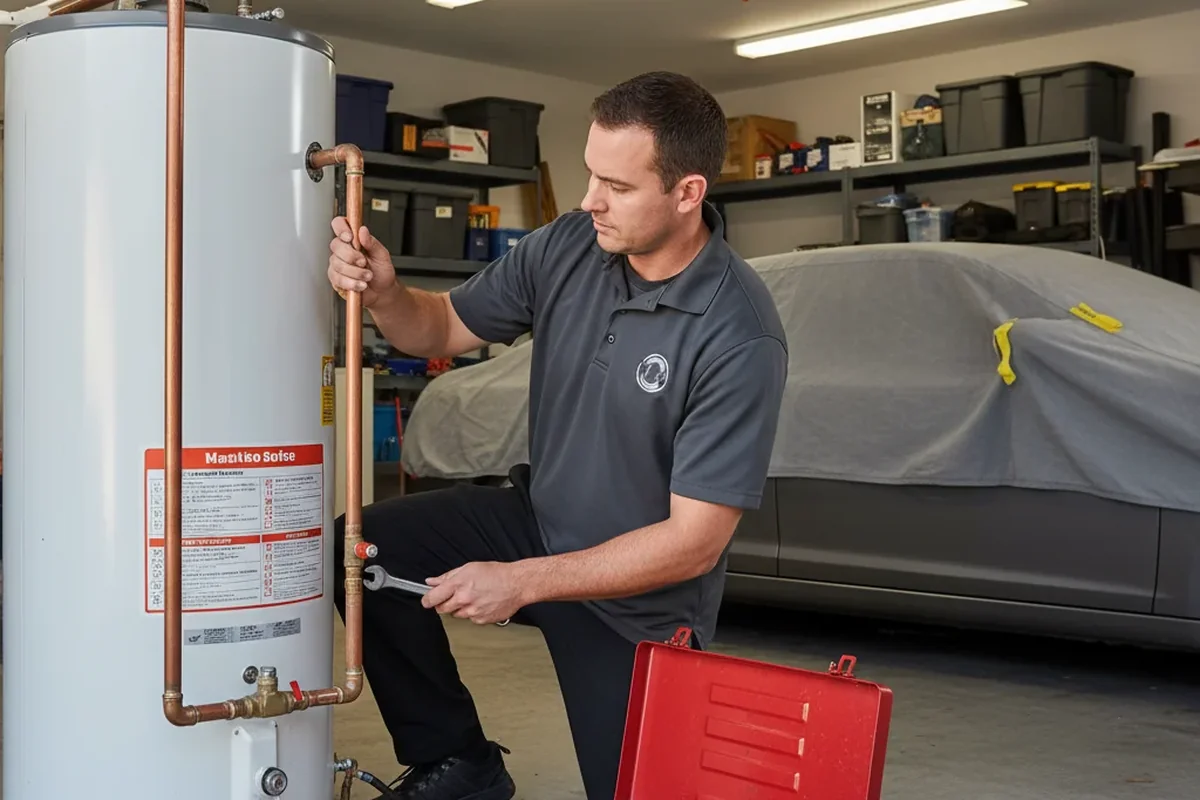
You walk into the garage and your shoe splashes. There is water spreading
out from the base of the water heater, and your first thought is the right one:
this will not fix itself. In Colton, that scene plays out in garages every single
week. Water Heater Leak Repair Crew exists for exactly this moment. We are the
local crew Colton homeowners call when a water heater starts leaking, seeps,
drips, or outright floods — and we show up ready to find the real source of the
water, not just mop it up and guess. Whether it is a slow seep from a valve or a full tank failure, the right next step is a proper diagnosis — and that is exactly what you get when you call.
Leaks here are rarely random bad luck. Colton's tap water comes largely
from Bunker Hill Basin groundwater blended with State Water Project imports, and
it is hard — loaded with dissolved calcium and magnesium. Every gallon your
heater warms leaves a little mineral behind. Year after year, that scale coats
heating elements, buries the bottom of the tank in sediment, and eats through
the sacrificial anode rod that is supposed to protect the steel tank. By the
time water appears on the floor, the inside of the tank has usually been losing
the fight for a long while. Add Colton summers that push 95 to 105 degrees,
baking the garages where most heaters live, and you get thermal stress on top
of mineral stress. The imported State Water Project water blended into the supply shifts with the seasons, but the groundwater minerals are a year-round constant.
Here is how we work. First we diagnose: is the water coming from the
tank body itself, or from a fitting, valve, or connection that can be repaired?
Tank leaks at the base or sidewall mean the unit is done, and we will tell you
that plainly. But a surprising number of so-called dead heaters are actually
suffering from a failed TPR valve, a corroded nipple, a split drain valve, a bad
thermostat, or a scaled-up element — all fixable, usually in one visit. When
replacement truly is the answer, we install a properly sized unit with a drain
pan and earthquake strapping the way California code requires. One call to
(833) 713-2101 gets you a straight answer and a technician at your door. Emergency calls get priority, because an active leak will not wait for a convenient appointment.
Why Water Heaters Leak in Colton, CA
Start with the water itself, because in Colton the water is the
story. The City of Colton utility delivers a blend of Bunker Hill Basin
groundwater and imported State Water Project supplies, and the groundwater
portion carries a heavy load of dissolved calcium and magnesium. That is what
hard water means in plain terms: minerals riding along invisibly in every
gallon. The moment water is heated, it cannot hold as much dissolved mineral,
so scale precipitates out — onto heating elements, along the tank walls, and
in a thickening blanket across the bottom of the tank. It happens slowly,
silently, and relentlessly, in every tank heater in the 92324.
That mineral blanket is where most Colton leaks are born. On a
gas unit, the burner fires underneath a layer of sediment instead of clean
steel, so the tank bottom overheats while the water above stays lukewarm —
that is the rumbling and popping homeowners hear, and it is the sound of the
tank's glass lining cracking under thermal stress. Meanwhile the anode rod,
the magnesium or aluminum rod hung inside the tank to corrode so the steel
does not have to, gets consumed at a brutal pace in hard water. In many parts
of the country an anode rod lasts four to six years. In Colton, two to four
is common, and plenty of homeowners have never heard of the part at all. Once
the rod is gone, nothing protects the steel. Rust starts from the inside out,
pinholes open at the bottom and along welds, and one morning there is water
on the garage floor.
Colton adds its own accelerants. Summer highs of 95 to 105 degrees
turn garages — where the vast majority of local heaters live — into ovens,
and the daily heat cycle works every joint, fitting, and valve a little
looser. The city's housing stock tells the rest of the story: 1950s through
1970s ranch homes with original-era galvanized nipples that corrode where
they thread into the tank top, 1980s to 2000s tract homes whose original
heaters are now deep into borrowed time, and a large rental stock where
maintenance flushing simply never happens. Mineral-crusted TPR valves that can
no longer open, plastic drain valves fused shut by scale, corroded dielectric
unions — these are the everyday findings on our service calls. The honest
math: a tank rated for ten to twelve years on its warranty card typically
gives Colton eight to ten, and only with some attention along the way.
Our Water Heater Leak Repair Services in Colton
We do one thing and we do it well: we fix leaking water heaters.
Not general plumbing, not remodels — leaks. That focus matters, because a
puddle under a heater can come from a dozen different sources and the fix for
each is different. Our first job on every call is leak detection: tracing the
water to its true origin. Is it weeping from the tank body itself? Running
down from a corroded hot or cold nipple on top? Dripping from the temperature
and pressure relief valve or its discharge pipe? Seeping from a cracked drain
valve? Condensation on cold inlet piping that only looks like a leak? We check
every one of these before we touch a wrench, because replacing a valve will
never fix a rusted-through tank, and replacing a whole heater will never be
necessary for a five-dollar fitting failure.
For tank-style heaters we repair the components that actually
fail in hard-water country: anode rod replacement before the tank is
compromised, drain valve replacement (we upgrade crusted plastic valves to
brass ball valves that will still turn years from now), TPR valve replacement
for valves that weep or have mineral-fused shut, heating element and
thermostat replacement on electric units whose elements have scaled over and
burned out, and gas control valve replacement when the gas valve itself is the
leak point or has stopped regulating. For tankless units we handle a different
failure set: descaling heat exchangers choked by Colton's minerals, repairing
leaks at water and gas connections, and sorting out condensate and pressure
relief drainage. And because California code requires drain pans in many
installations — and because a pan with a proper drain line is the cheapest
flood insurance a garage heater can have — we install and retrofit pans that
actually drain somewhere safe.
When the diagnosis says the tank itself has failed, we handle
full water heater replacement too: correctly sized for your household, set to
a safe temperature, strapped for earthquakes the way California requires,
panned, and hauled-away when the old unit comes out. Active leak right now?
That is what our emergency water heater leak repair service is for — water
spreading across the floor does not wait for business hours, and neither do
we. Every job ends the same way: the unit tested, the area dried as best we
can, and you shown exactly what failed and what we did. Call (833) 713-2101
and tell us what you are seeing — we will tell you what it likely is before
we ever roll a truck.
What Happens When You Call: Our Repair Process
It starts with a phone call to (833) 713-2101 — a real person
answers, not a phone tree. Tell us what you are seeing in plain words: water
on the floor, a hissing sound, no hot water this morning, a rusty tint in the
tap. We will ask a few quick questions that help us arrive prepared: gas or
electric, tank or tankless, roughly how old the unit is if you know, and where
exactly the water is showing up. Then we set an arrival window and give you
simple wait-safe steps: where the cold-water shutoff above the heater is and
which way to turn it, what to do if you smell gas (leave the house and call
the gas company first — always), and which breaker to flip if the unit is
electric. You will know what is happening before we hang up.
On arrival, the technician does the diagnosis before the repair.
We work top to bottom: inlet and outlet nipples and dielectric unions on top,
the TPR valve and its discharge pipe, the gas control valve and burner
assembly on gas units, thermostats and elements on electric units, the drain
valve, and finally the tank base and welds. We look for the mineral crust,
green corrosion, and rust trails that tell the story of where water has been
traveling — because water runs downhill and the puddle is rarely directly
under the failure. Then you get a straight explanation in everyday language:
here is what is leaking, here is why it happened, here are your options, and
here is the price before we start. No work begins until you say go.
The repair itself is usually done in a single visit — most of
the parts that fail on Colton heaters are standard items we carry on the
truck. We test the unit under pressure, check the temperature setting, look
over the remaining fittings for the next failure waiting to happen, and clean
up the work area. If the diagnosis shows the tank itself is breached, we walk
you through replacement instead: sizing, a drain pan with a real drain path,
and earthquake strapping brought up to current California requirements. Either
way you will know exactly what was wrong, what we did about it, and what to
watch for next. That is the whole process — call, diagnose, fix, verify —
and it starts at (833) 713-2101.
Colton Hard Water: What It Does to Your Water Heater
A quick bit of science, because understanding it saves Colton
homeowners real money. Hard water is simply water carrying dissolved rock —
mostly calcium and magnesium picked up as groundwater moves through the
Bunker Hill Basin. Cold, the minerals stay dissolved and invisible. Heated,
the water can no longer hold them, so they crystallize out as scale on the
hottest surfaces they can find: the lower heating element, the tank bottom
above the burner, the inside of the heat exchanger on a tankless unit. A
water softener removes the minerals before they ever reach the heater, but
most Colton homes do not have one, so every tank in town is quietly
collecting sediment from the day it is installed.
The damage compounds. Sediment is an insulator, so a burner or
element buried under an inch of it must run far longer to heat the same water
— your gas or electric bill climbs while the tank steel itself overheats,
cracking the glass lining meant to protect it. Scale-coated electric elements
develop hot spots and burn out years early. Dissolved minerals also attack the
anode rod first by design; that rod is the tank's bodyguard, and in Colton
water it can be consumed in two to four years. After that, corrosion goes
straight for the steel. And the safety hardware suffers too: TPR valves crust
over with mineral deposits until they can no longer snap open in an
overpressure event, which turns a safety device into a decoration.
None of this is destiny — it is maintenance. An annual flush
drains the sediment before it hardens into concrete-like scale, and checking
the anode rod every couple of years in Colton water catches a spent rod
before the tank starts paying the price. The catch: on heaters that have gone
a decade without attention, the factory plastic drain valve is often fused
shut with scale, and forcing it can snap the valve off in the tank. That is
why our flush service includes replacing that fragile plastic valve with a
full-port brass ball valve — so next year's flush takes minutes instead of
courage. If your heater rumbles, pops, or takes forever to recover, that is
sediment talking. Call (833) 713-2101 before it becomes a leak talking.
Repair or Replace? An Honest Answer for Colton Homeowners
Every leaking-heater call eventually reaches the same question,
and there is an honest framework for answering it. The leak's location decides
more than anything else. Water coming from the tank body itself — the base,
the sidewall, a weld seam — means the steel has rusted through, and no
reputable technician can repair that. Sealants, patches, and wishful thinking
do not restore structural steel that is corroding from the inside. When we
find a breached tank, we say so directly and talk replacement, because selling
you a valve job on a dead tank would be theft. But a large share of the leaks
we see are not tank failures at all: they are failed nipples, unions, drain
valves, TPR valves, elements, thermostats, and gas valves — all repairable,
often the same day, for a fraction of replacement cost.
Age is the second input, and Colton's hard water rewrites the
usual chart. Nationally, a tank heater is often quoted at ten to twelve
years; in the 92324, eight to ten is the realistic range without diligent
maintenance. Under about six years old with a component failure — a burned
element, a weeping TPR valve, a corroded nipple — repair is almost always the
smart money. Past eight years with rusty hot water, rumbling sediment, and
now a leak, you are usually better off putting the repair dollars toward a
new unit rather than nursing a tank through its final year one part at a
time. We check the manufacture date on the rating plate, assess the tank's
overall condition, and lay both options out with real numbers so the decision
is yours, informed.
There is a third angle worth weighing: efficiency and code. A
replacement done today meets current Title 24 efficiency standards, gets a
drain pan with a proper drain path instead of the missing or cracked pan we
so often find, and gets earthquake strapping that meets California's current
requirements — three upgrades that protect both your home and your wallet.
What we will never do is push replacement when a repair is the right call.
If your four-year-old heater needs a thermostat, you get a thermostat, not a
sales pitch. That is the deal: we diagnose honestly, price the options
upfront, and let the facts decide. Call (833) 713-2101 and get an answer you
can trust, even if the answer is the cheaper one.
Proudly Serving Colton and the Inland Empire
Colton is our home turf, and we know its heaters the way only a
local crew can. This is the Hub City — founded in 1875, incorporated in 1887
and named for Southern Pacific Railroad figure David D. Colton, built around
the Colton Crossing rail junction where the I-10 and I-215 now meet. We work
in the historic neighborhoods near downtown, in the 1950s through 1970s ranch
homes whose garages hold the oldest heaters in town, in the 1980s to 2000s
tracts, and in the infill and rental properties in between. From homes near
Fleming Park to families spending weekends at Fiesta Village Family Fun Park
to history buffs at the Colton Area Museum, our customers are our neighbors —
and their water is our water, the same hard Bunker Hill Basin blend, which
means we have seen exactly what it does to a heater, hundreds of times over.
Our service area covers Colton first and the surrounding
Inland Empire communities every day: Bloomington, Rialto, and Fontana to the
west; Grand Terrace, San Bernardino, and Highland to the north and east; Loma
Linda and Redlands beyond; Muscoy and the neighborhoods along the Santa Ana
River; and the wider ring of Yucaipa, Calimesa, Beaumont, Rancho Cucamonga,
Ontario, Montclair, Upland, Chino, Norco, Eastvale, Riverside, and Moreno
Valley. Same region, same water chemistry, same housing stock, same
California code requirements — so the diagnosis we would give your neighbor
in Rialto applies to your garage in Colton, and the parts on our trucks are
the parts Inland Empire heaters actually need.
Being local is a practical advantage, not a slogan. We do not
need a map to find your street, we know which Colton neighborhoods run on
which water pressure zones, and we can usually get a technician to an active
leak the same day you call. When you dial (833) 713-2101 you reach people who
work these streets every day — people who will still be here if you ever need
us again. Water heater leaking? Do not wait for the puddle to find your
drywall. Call now and let the local crew sort it out.
Our Water Heater Leak Repair Services
Walk into your garage on a 102-degree Colton afternoon and you may notice it before you see it: a faint mineral smell, a dark halo spreading across th
A tankless water heater is not a tank with the tank removed. It is a precision machine: a copper or stainless-steel heat exchanger threaded with water
The most expensive water heater leaks are the ones you never see. In Colton, they hide with embarrassing ease: garage concrete wicks a slow drip outwa
Inside every tank water heater in Colton there is a metal rod with one job: to die so the tank doesn't have to. It's called the anode rod — usually ma
Every tank water heater has one part whose entire job is preventing a catastrophe: the temperature-and-pressure relief valve, the little brass valve t
It's the most-touched, least-thought-about part on your water heater: the little spigot near the bottom of the tank, the one you (or somebody) use onc
Gas valve failing in Colton, CA? Pilot won't stay lit or no hot water? We replace gas control valves fast.
No hot water in Colton, CA? Burned-out heating elements are common in hard water. We replace elements fast.
Water too hot or cold in Colton? A faulty thermostat wastes energy and risks scalding. We replace them fast.
Water heater flooding in Colton, CA? Burst tank or major leak? We respond fast to water heater emergencies.
Old water heater leaking in Colton, CA? We assess whether repair or replacement saves you more.
No drain pan under your Colton, CA water heater? One leak can ruin floors and walls. We install pans right.
Areas We Serve in San Bernardino County
Downtown Colton is where the city began — a railroad town laid out when the Southern Pacific arrived in the 1870s, and the historic core still carries
South Colton sits below Interstate 10 on the Santa Ana River side of the city, a neighborhood of 1950s-through-1970s ranch homes on slab foundations —
North Colton, up against Interstate 215, is the city's mixed-use belt — older single-family streets stitched between commercial corridors, light indus
West Colton runs along the Rancho Avenue corridor out to the city's industrial edge — warehouses, distribution yards, truck terminals, and contractor
Reche Canyon is Colton's country side — a winding rural-residential canyon of estate homes, horse properties, and large lots tucked into the hills sou
La Loma Hills rises above central Colton in terraced streets of 1960s-through-1980s hillside homes — split-levels and two-stories with view lots, down
San Bernardino's 92408 covers the south-central part of the county seat — a wide, varied swath of the city where housing eras collide. Within a few bl
Grand Terrace sits between Colton and Loma Linda in the shadow of the Blue Mountain foothills — a quiet, family-oriented suburb of 1960s-through-1980s
Loma Linda is a university and medical town first and a suburb second — home to Loma Linda University and its medical center, which shape everything a
Bloomington is the Inland Empire's holdout country — an unincorporated semi-rural community of older ranch homes on large lots, horse properties, and
Rialto — the 'Bridge City' — grew up as a post-war boomtown, and the 92376 still shows it: street after street of 1950s-through-1970s tract homes, the
Fontana grew up around steel, and a lot of its housing grew up right alongside it. The neighborhoods south of the old Kaiser mill site still hold mid-
Highland sits where the old citrus belt meets the San Bernardino foothills, and its homes carry that history in their bones. The original town holds r
Redlands is the Inland Empire's grande dame — orange groves, the university, and streets of Queen Annes and Craftsman homes that predate the automobil
Mentone is a small town with a big personality — the old Santa Fe depot, the canyon mouth at its back, and a stock of older cottages, cabins, and ranc
Muscoy is unincorporated San Bernardino County — semi-rural, mixed, and proud of it. The 92407 ZIP holds older ranch houses on generous lots, manufact
Yucaipa sits higher than the valley floor — a foothill town where the air runs cooler, the lots run bigger, and the water heaters work harder than mos
Rancho Cucamonga is the Inland Empire's planned-community showcase — wide boulevards, eucalyptus windrows, and neighborhood after neighborhood of 1980
Ontario wears its history on Euclid Avenue — the median-lined boulevard, the historic downtown, and neighborhoods of early-20th-century homes that gre
Upland is a city of two characters: the historic downtown and its surrounding streets of early-20th-century homes, and the foothill estates climbing t
Chino grew up on dairy and agriculture, and the 91710 ZIP still shows it — older farmhouses and ranch homes on generous lots in the north and west, gi
Montclair is the classic mid-century suburb — the Montclair Plaza era, the I-10 corridor, and neighborhood after neighborhood of 1950s through 1970s r
What Colton Homeowners Say
“I found water all over the garage floor one morning and
panicked. They came out the same day, showed me the rusted-out bottom of the
tank, and had a new one installed before dinner. No upsell, no scare tactics
— just straight answers and clean work.”
Maria G. — near Fleming Park
“Our heater had been making that popping noise for months
before it started leaking. The technician explained it was sediment from the
hard water, flushed what he could, and replaced the drain valve. He told us
honestly the tank probably had a year or two left instead of pushing a new
one on us.”
James R. — West Colton
“The valve on top kept dripping and two other companies told
me I needed a whole new water heater. These guys replaced the relief valve
and a corroded fitting in under an hour. They saved me from spending money I
did not need to spend.”
Denise W. — South Colton
Latest from the Blog
Learn the 6 early warning signs of a leaking water heater in Colton, CA — puddles, rust, pressure drops and more. Call (833) 713-2101 for fast local s
Colton's hard water cuts water heater life by years. Learn how minerals attack tanks, anode rods and elements — and how to fight back. Call (833) 713-
The anode rod is your water heater's best defense against Colton's hard water — but it dies in 2-4 years here. Learn to inspect and replace it. (833)
A dripping TPR valve is a warning sign, not a nuisance. Learn why water heater relief valves leak and what to do safely in Colton. Call (833) 713-2101
California requires drain pans under water heaters in many installations. Learn pan sizing, drain line rules, and garage requirements. (833) 713-2101.
Do tankless water heaters leak less than tank models? Compare leak risks, failure modes and hard-water concerns for Colton homes. Call (833) 713-2101.