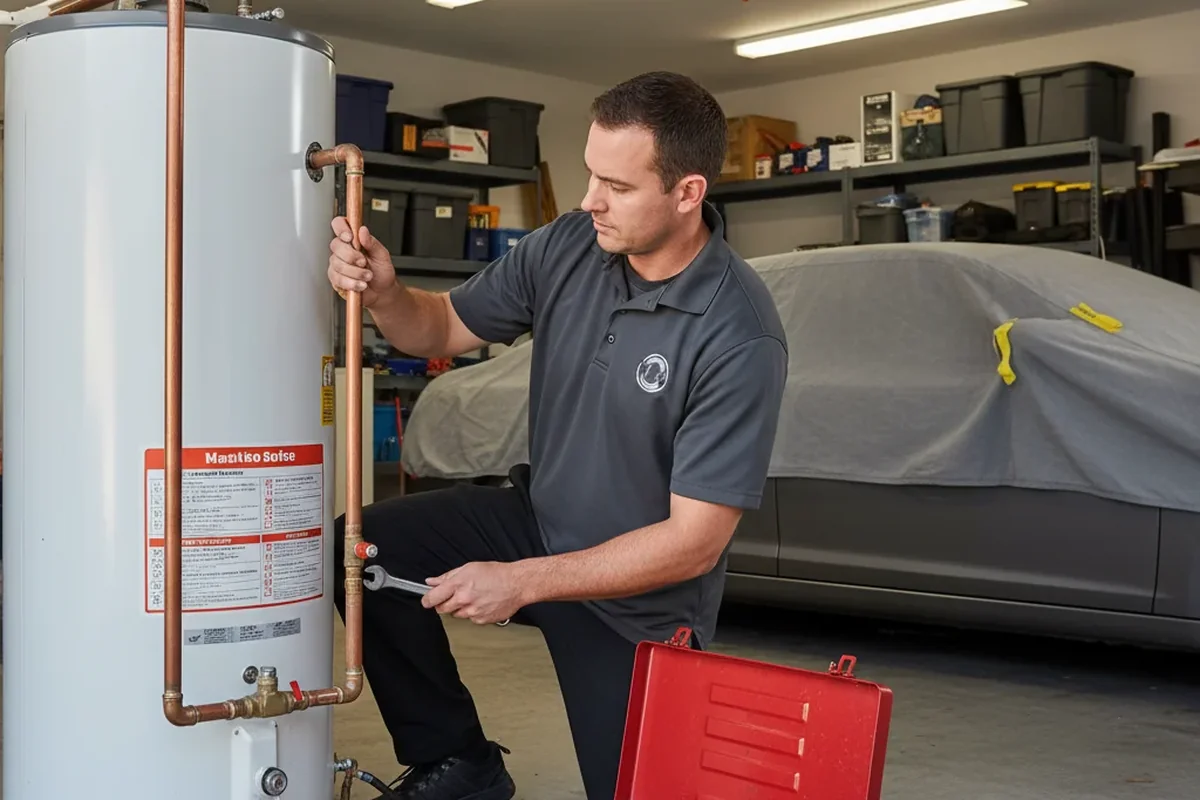
Drain Valve Replacement Service in the 91763 Area
There are two ways a drain valve fails, and both end maintenance. The first is the clog: sediment packs the valve's internal passages until water barely trickles, and no amount of flushing clears it because the flush itself has to go through the clog. The second is the seal failure: the washer or seat gives out and the valve weeps constantly, or the plastic body cracks and drips. A valve that won't open and a valve that won't close are equally useless — one prevents flushing, the other wastes water and feeds base corrosion. Replacement solves both, and upgrading from plastic to brass at the same time means the new valve won't fail the same way.
In Montclair, that maintenance gateway matters more than in most places: Montclair's hard water has been attacking the same 1960s-70s galvanized plumbing for half a century. When the valve can't pass sediment, the tank loses its only cleaning mechanism — and in this water, sediment never stops arriving. The valve isn't a minor fitting here; it's the fitting the entire tank-maintenance plan depends on.
When Montclair Homeowners Need a New Drain Valve
Age and material tell the story before symptoms do. If the valve is the original plastic spigot and the heater is more than six or seven years old in Montclair's heat, the valve is living on borrowed time — plastic valve bodies distort, washers harden, and the next time someone touches it may be the time it breaks. Technicians proactively recommend the brass upgrade during any service visit where the valve shows its age, because a valve replaced on schedule costs the same as a valve replaced in crisis, but without the water damage or the ruined flush in between.
Those symptoms read differently against Montclair's housing: 1960s-70s ranch tracts with original plumbing still in service, tight garages with poor combustion air. Original valves and bottom nipples that have been seizing for decades don't just clog — they snap, seize, and crumble, which is why the symptom list here skews toward valves that break rather than valves that merely drip. The technician treats every old valve as fragile until proven otherwise.
What Happens During a Drain Valve Visit in Montclair
When the old valve has snapped off flush with the tank — the classic plastic-valve failure — extraction becomes a small surgical operation. The remaining threaded stub has to come out without damaging the tank's internal threads, which means specialized extractors, heat, and patience rather than force. Forcing it risks cracking the tank's threaded boss or twisting the internal fitting, either of which turns a valve replacement into a tank replacement. This is the part of the job where experience shows: knowing how much persuasion the fitting can take, and when to change tactics.
Every Montclair valve replacement starts with the drain plan: 1960s-70s ranch tracts with original plumbing still in service, tight garages with poor combustion air. Where the heater sits boxed into a closet or a low utility space, the technician may pump the drawdown to a distant drain rather than relying on gravity, and the hose path gets protected like the work area — because forty gallons of sediment-laden water only needs one mistake to become a flooring claim.
Montclair Water and Heat vs. Your Drain Valve
Two local factors conspire against drain valves in Montclair: mineral-heavy water and sustained heat. The minerals settle exactly where the valve sits, packing its passages with scale and sediment; the heat — months of high ambient temperature around the tank — distorts plastic valve bodies, hardens washers, and bakes the sediment into a cement-like mass. A valve that might last a decade in mild, soft-water conditions can be clogged or weeping in half that time here. The professional answer is material: full-port brass, which resists heat distortion, passes sediment the plastic valve would choke on, and seals with a quarter-turn ball mechanism instead of a washer that hardens.
The 91763 climate writes the failure timeline: 95F+ summers; tight garages become heat traps with poor ventilation. Thermal cycling fatigues plastic over thousands of hot-cold cycles, and each summer bakes the sediment packed around the valve a little harder. Valves that might last a decade in mild conditions give up in five or six here — unless they're brass, which simply doesn't fatigue this way.
Flushing Schedules for Montclair Water Heaters
The long-term economics are straightforward. A water heater that gets flushed annually in hard water lasts meaningfully longer than one that doesn't — and the flush depends entirely on the drain valve. The valve replacement is a small service that unlocks years of maintenance; skipping it converts a maintainable tank into a disposable one. For Montclair homeowners, the math is especially favorable because the water is hard enough that the maintenance actually matters — this isn't theoretical diligence, it's the difference between a tank that dies at eight years and one that's still going at twelve.
Zoom out and the economics are plain: Montclair's hard water has been attacking the same 1960s-70s galvanized plumbing for half a century, and a maintained tank outlives a neglected one by years in the 91763 area. The valve replacement is a small service that unlocks all of that maintenance — skipping it converts a maintainable tank into a disposable one, which is the most expensive possible outcome for a ten-dollar fitting.
A quick assessment settles it: valve condition, sediment load, tank soundness, and a flush that leaves the tank healthier than it started. Call (833) 713-2101 for service anywhere in the 91763 area.